31 May 2026
Echo Chambers of Code: How Feedback Loops in Simulation Software Accelerate Iterative Design Processes for Virtual Reality Training Modules
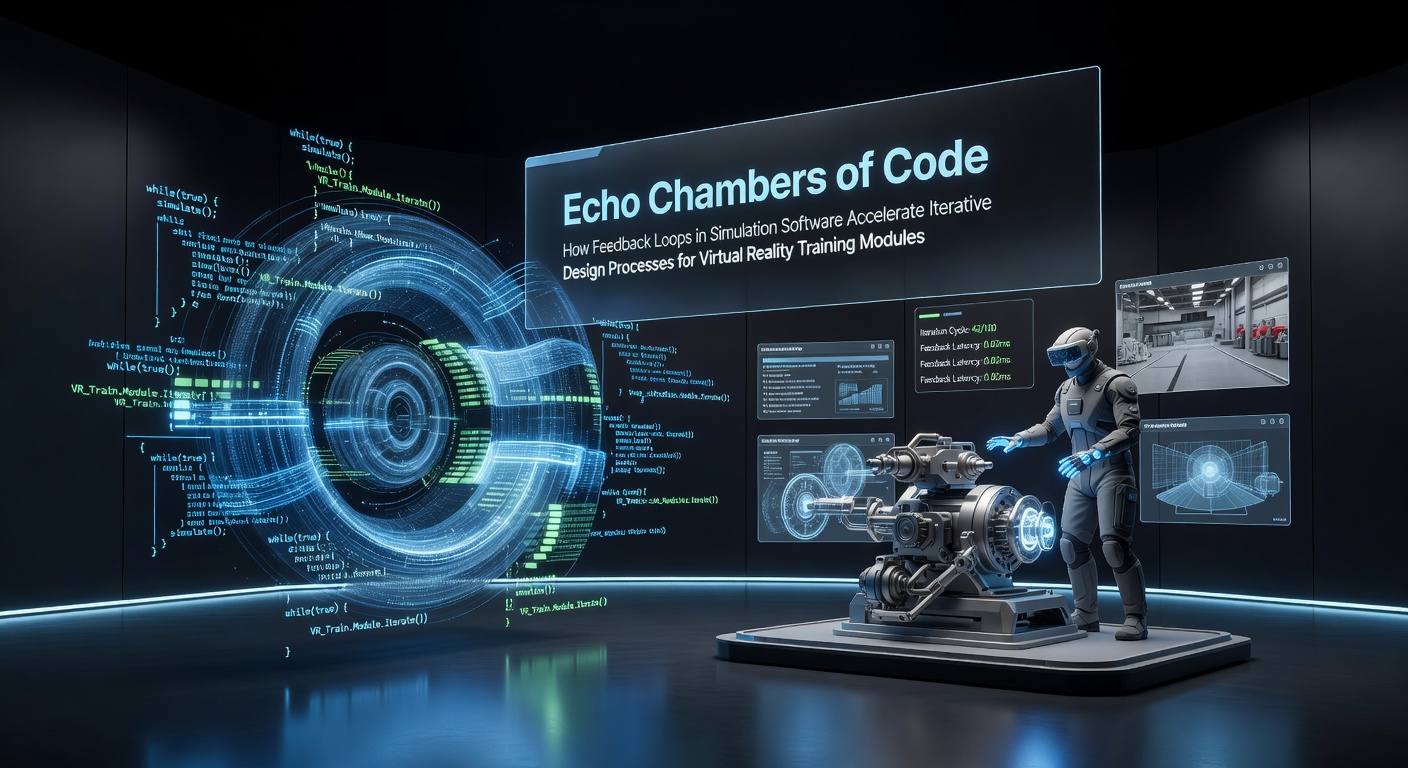
Simulation software has evolved into a core component of virtual reality training development, where feedback loops embedded in code allow design teams to refine scenarios through continuous data cycles rather than isolated revisions. These loops capture user interactions, environmental variables, and performance metrics inside the simulation, then feed that information directly back into the system for immediate adjustments. Researchers at institutions studying immersive technologies note that this process reduces the time between initial prototyping and functional module deployment by integrating analysis steps into the runtime environment itself.
Mechanics of Feedback Loops in Simulation Code
Feedback loops operate by monitoring variables such as trainee movement patterns, decision timing, and environmental responses within the virtual space, then routing those signals through algorithms that recalibrate difficulty, object placement, or narrative branches on the fly. In practice this means a medical training module can adjust the behavior of virtual patients based on procedural errors logged during a session, while the same code layer logs thermal data or spatial constraints to inform future iterations without requiring external review. Engineers designing these systems often structure the loops around modular code segments that isolate specific parameters, allowing targeted updates while preserving overall simulation stability across multiple training runs.
Studies conducted through collaborative projects between universities and defense contractors show that such architectures support rapid cycling because each loop iteration draws from accumulated session data rather than starting from static baselines. This approach contrasts with earlier linear design workflows where changes required separate testing phases separated by days or weeks of manual code review.
Impact on Iterative Design Timelines
Iterative design gains measurable acceleration when simulation software closes the gap between execution and evaluation. Design teams working on industrial safety modules, for instance, can deploy a new hazard scenario in the morning and receive aggregated performance statistics by afternoon that directly influence the next build. Data compiled by the National Research Council of Canada indicates that organizations using integrated feedback systems completed full module revisions in cycles averaging 40 percent shorter than those relying on post-session analysis alone. The loops handle routine parameter tuning automatically, freeing developers to focus on higher-level structural changes such as branching storylines or multi-user synchronization.
Observers tracking software practices in training applications point out that these systems also maintain consistency across distributed teams because the code base serves as a shared reference point updated in real time. When one contributor modifies an object interaction rule, the loop propagates the effect to all connected instances, eliminating version conflicts that previously slowed collaborative projects.

Applications Across Training Domains
Virtual reality training modules in aviation, healthcare, and emergency response have adopted these feedback mechanisms to handle complex skill sets that demand repeated practice under variable conditions. In aviation contexts the loops track pilot responses to simulated system failures and adjust turbulence parameters or instrument readouts accordingly, creating sequences that progressively challenge specific weaknesses identified in prior runs. Healthcare modules use similar structures to refine surgical precision by logging hand tremor data and tissue interaction forces, then generating follow-up scenarios that emphasize the recorded deficiencies.
Emergency response programs benefit when loops incorporate crowd behavior models that evolve based on trainee decisions, producing crowd dynamics that reflect real patterns observed during actual incidents. Reports from the IEEE Virtual Reality conference series document how these adaptive elements allow training centers to scale personalized instruction without proportional increases in staff or hardware resources.
Developments Observed in Early 2026
During May 2026 several industry gatherings highlighted expanded use of feedback-driven simulation tools in public sector training programs. Presentations at those events featured case data from European aerospace consortia showing that loop-enabled modules supported simultaneous training for crews across multiple sites while maintaining synchronized difficulty progression. The same sessions noted integration of sensor fusion techniques that combine eye-tracking outputs with physiological readings, feeding richer datasets into the loops and further shortening refinement intervals.
Academic papers presented alongside these discussions described code frameworks that isolate loop functions within containerized environments, allowing rapid testing of new variables without risking core simulation integrity. These technical advances align with broader trends toward modular software design that supports both commercial and government training contracts.
Conclusion
Feedback loops embedded in simulation software have established a practical pathway for accelerating iterative design in virtual reality training modules by embedding evaluation directly into operational cycles. Organizations across multiple sectors now rely on these mechanisms to compress development timelines while preserving scenario fidelity and user-specific adaptation. Continued refinement of loop architectures, supported by data from ongoing research initiatives, continues to shape how training content evolves in response to performance metrics captured inside the virtual environment.