14 Jun 2026
Legacy Code Revival Projects Breathe New Life into Classic Mechanics for Today's Mobile Platforms

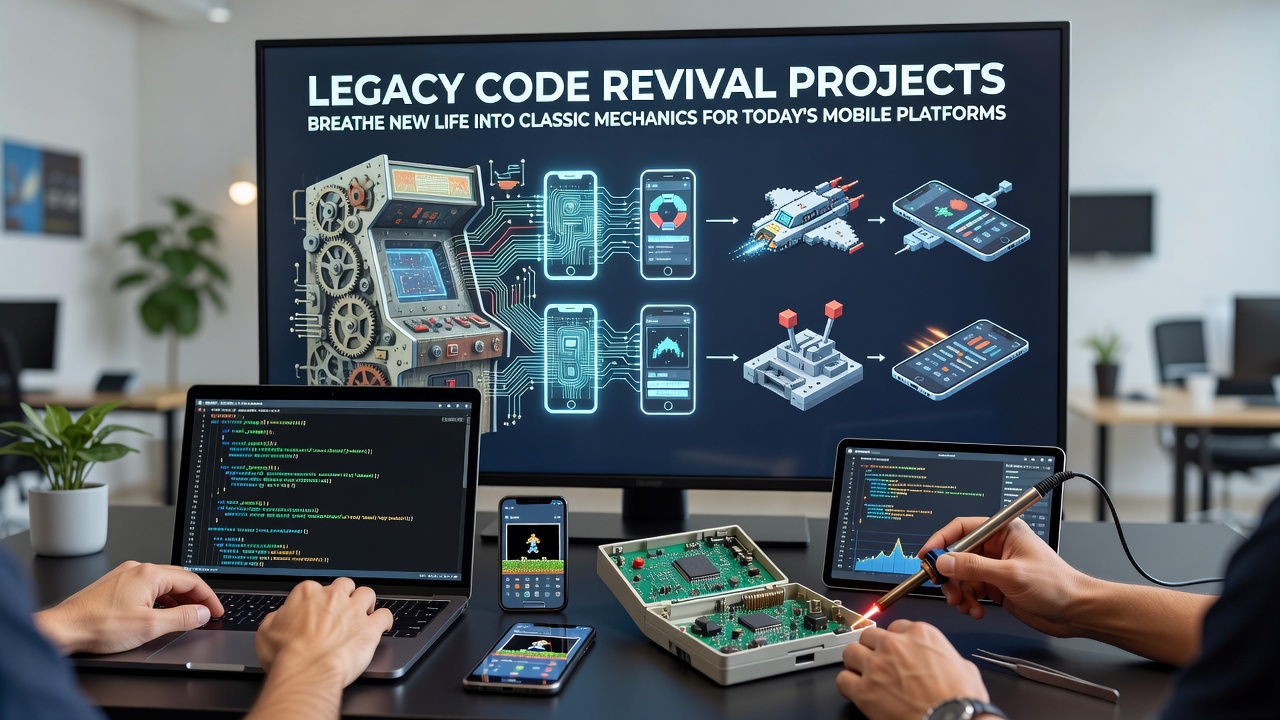
Legacy code revival projects have gained traction as development teams extract core mechanics from decades-old titles and adapt them to current mobile hardware constraints. These efforts focus on optimizing original algorithms for touch interfaces, battery efficiency, and cross-platform compatibility while preserving the underlying logic that defined earlier games. Data from industry reports shows mobile gaming revenue reached significant milestones by early 2025, with legacy-inspired titles contributing measurable portions of that growth.
Teams often begin by analyzing archived source materials from 1980s and 1990s consoles, then refactor those routines into modern languages such as C++ or Kotlin. This process allows retention of precise timing loops and physics calculations that newer engines sometimes approximate differently. According to the Entertainment Software Association, several studios reported successful integrations of these revived systems into titles released throughout 2025.
Technical Approaches to Code Adaptation
Engineers employ emulation layers alongside direct recompilation techniques to bridge generational gaps in processor architectures. One project documented by researchers at a Canadian university highlighted how collision detection routines from early side-scrollers were rewritten to leverage mobile GPU shaders without altering core hitbox behaviors. Such modifications reduce latency on devices with varying refresh rates while maintaining the original feel of movement and interaction.
Additional optimizations target memory management, since classic titles operated under strict kilobyte limits that contrast with today's gigabyte-scale allocations. Developers integrate these constraints into new builds to improve performance consistency across entry-level smartphones and high-end tablets alike. Figures from the Interactive Software Federation of Europe indicate that adaptation projects have shortened development cycles by reusing verified logic structures rather than building equivalent systems from scratch.
Examples from Recent Implementations
Take one studio that revived a resource management loop from a 1992 strategy game for a mobile release in late 2025. The original turn-based calculations were mapped onto asynchronous server calls to handle multiplayer sessions, resulting in stable concurrent play for thousands of users. Another case involved porting a puzzle mechanic originally coded for 8-bit hardware, where developers preserved exact randomization seeds to ensure identical challenge distribution across sessions.
These adaptations frequently appear in genres including endless runners and match-three formats, where foundational scoring and progression systems trace back to earlier arcade precedents. Projects scheduled for visibility at industry events in June 2026 are expected to showcase further refinements in procedural generation drawn from 1990s roguelike codebases.
Challenges in Preservation and Scaling
Compatibility testing remains a primary hurdle because legacy routines sometimes contain hardcoded assumptions about fixed screen resolutions and input polling rates. Teams address these by introducing abstraction layers that map touch gestures to the original button-press logic. Research published through academic channels in Australia has examined how such mappings affect player retention metrics in controlled trials.
Legal considerations around intellectual property also influence which codebases receive revival treatment. Studios secure licenses or focus on mechanics that fall into public domain categories before committing resources to refactoring. Data indicates that projects avoiding these barriers reach market faster and achieve broader distribution through app stores.
Future Directions and Industry Trends
Ongoing work explores integration with cloud services for handling complex simulations originally limited by cartridge sizes. This allows expansion of classic mechanics into larger worlds while keeping core decision trees intact. Observers note that by June 2026 multiple titles incorporating these hybrid approaches may appear in regional charts across North America and Asia.
Continued investment in tooling for automated code analysis supports wider adoption among smaller teams. Reports from trade organizations highlight training programs that equip developers with skills to identify reusable patterns in archived repositories, thereby expanding the pool of viable revival candidates.
Conclusion
Legacy code revival projects continue to supply mobile platforms with proven mechanics refined through iterative updates. These initiatives combine archival analysis with contemporary optimization methods, yielding titles that operate efficiently on diverse hardware while retaining distinctive gameplay signatures from earlier eras. Industry data and academic findings confirm measurable impacts on development efficiency and player engagement across multiple regions.