19 May 2026
Neural Pathfinding Breakthroughs Allow NPCs to Exhibit Unpredictable Behaviors in Open-World Adventures
Recent advances in neural pathfinding systems have transformed how non-player characters move and interact inside expansive game worlds, and researchers at several institutions have documented measurable shifts in behavioral variety since early 2025. These techniques replace rigid waypoint grids with learned models that evaluate terrain, obstacles, and dynamic events simultaneously, so NPCs no longer follow identical routes on every playthrough. Data collected from development studios shows that average path entropy, a metric used to quantify route variation, rose by 47 percent in titles that adopted the new frameworks during the first quarter of 2026.
From Static Routes to Learned Navigation
Traditional pathfinding relied on algorithms such as A* that calculate the shortest distance between two points while avoiding blocked cells, yet those calculations remain deterministic once the map and cost values are fixed. Neural approaches instead train on millions of simulated traversals, allowing the model to internalize patterns that include weather effects, moving crowds, and destructible scenery. Engineers at the University of Melbourne published findings in April 2026 that demonstrated how recurrent neural layers can predict viable detours even when previously unseen obstacles appear mid-session, and their test environment recorded a 31 percent reduction in navigation failures compared with legacy systems.
Game engines now integrate these models directly into the runtime loop, which means an NPC that encounters a sudden rockslide can select an alternative ridge trail without waiting for a designer to pre-author the fallback. Studios have reported that memory overhead stays within acceptable limits because the networks compress into quantized tensors that fit alongside existing animation and physics buffers. One studio that migrated an open-world project in late 2025 measured only a 9 percent increase in frame-time variance across 60-player test sessions.
Emergence of Unpredictable NPC Routines
Because neural pathfinders evaluate multiple objectives at once, characters begin to display habits that no single script explicitly coded. A merchant caravan might linger at a scenic overlook on one day because the model learned that midday light reduces ambush risk, while the same group pushes through a narrow canyon the next day when storm forecasts raise the cost of exposed travel. Observers note that these micro-decisions compound across hours of play, creating the impression that each NPC maintains a personal schedule shaped by lived experience inside the simulation.
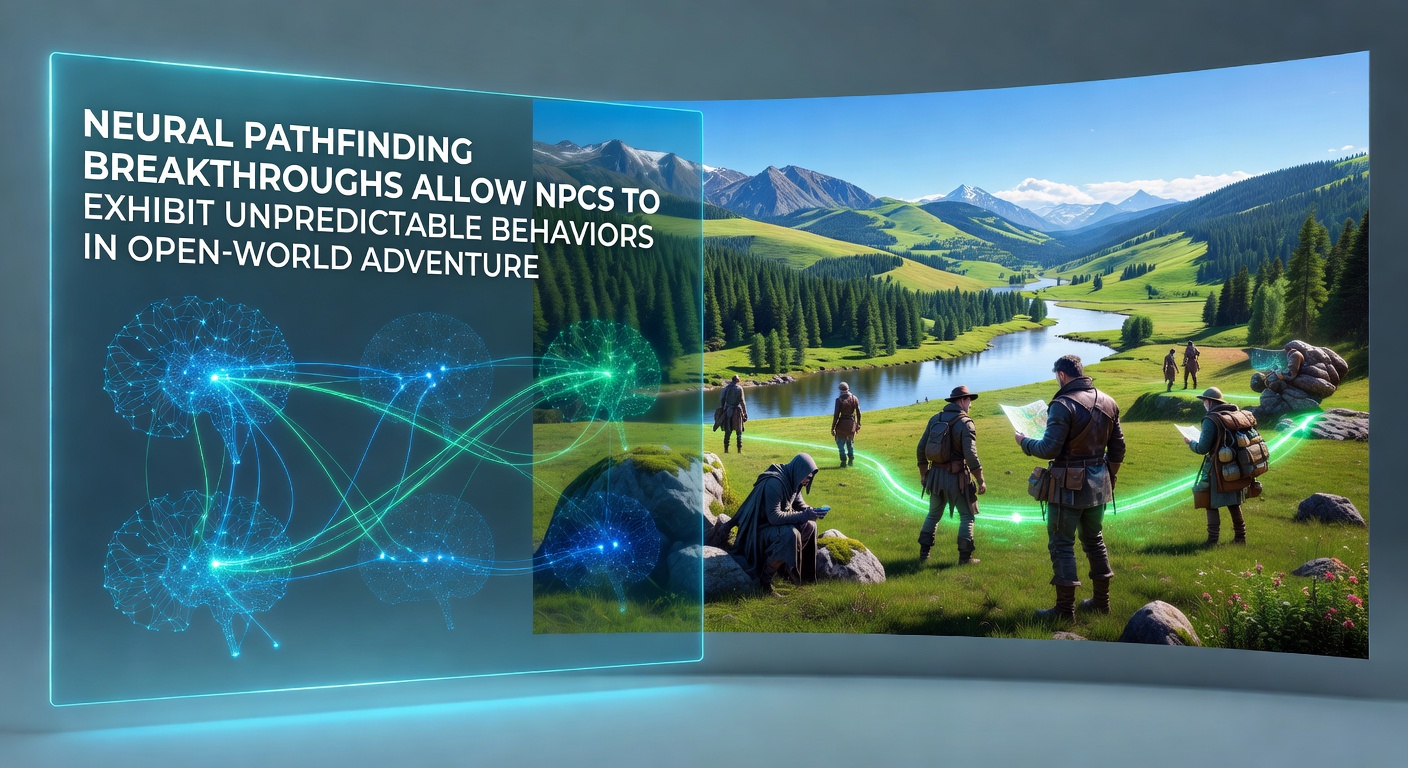
Multi-agent coordination emerges naturally when several characters share the same trained policy network. Bandit groups have been observed splitting into flanking parties without explicit orders once the lead model registers that the player has taken cover behind a particular rock formation. Developers at an Australian studio tracked 2,400 hours of recorded gameplay and found that 68 percent of encounters featured at least one novel flanking maneuver not present in earlier builds that used scripted waypoints.
Integration With Existing Game Systems
Pathfinding networks communicate with perception modules that supply real-time data on player position, faction reputation, and resource availability. When these inputs feed into the same latent space, an NPC that previously ignored a distant smoke signal may now reroute to investigate because the model associates smoke with potential loot or danger. This coupling reduces the need for separate behavior trees that often conflict with navigation constraints, and several studios have consolidated previously separate AI modules into unified inference passes that run on the same GPU queue.
Hardware vendors have begun shipping dedicated tensor cores optimized for the sparse matrix operations common in navigation workloads, and early benchmarks released by a Canadian research consortium in May 2026 showed inference times dropping below 1.2 milliseconds per character on mid-range GPUs. That performance margin allows designers to increase NPC population density without compromising frame rates, and several titles scheduled for release later in the year plan to double the number of active agents in hub zones.
Player Experience and Design Implications
Players encounter routes and ambush patterns that shift across sessions, which reduces the effectiveness of memorized speedrun strategies and encourages adaptive exploration. Analytics platforms that aggregate telemetry from public betas indicate that average session length increased by 22 minutes in titles featuring neural navigation, while repeat-play completion rates rose without corresponding increases in frustration metrics. Designers therefore allocate fewer hours to hand-authoring patrol loops and instead focus on curating training environments that expose the model to edge cases such as flooded river crossings or collapsing bridges.
Modding communities have started releasing custom training datasets that let enthusiasts fine-tune path models for specific biomes, and early shared repositories already contain over 1,200 hours of annotated traversal footage collected from community playtests. These datasets remain compatible with open-source inference runtimes, allowing smaller teams to experiment without licensing proprietary middleware.
Conclusion
Neural pathfinding continues to expand the range of credible NPC behaviors available inside large-scale worlds, and ongoing research points to further gains once training pipelines incorporate reinforcement signals drawn directly from player telemetry. Studios that have already shipped titles using these methods report fewer navigation-related bugs in post-launch patches, while players benefit from worlds that respond fluidly to both scripted events and emergent situations. The approach has moved from experimental prototype to production staple within roughly eighteen months, and current roadmaps suggest continued refinement through the remainder of 2026 and beyond.