28 Jun 2026
Subatomic particle modeling brings unprecedented realism to fluid interactions within physics-heavy simulation releases worldwide
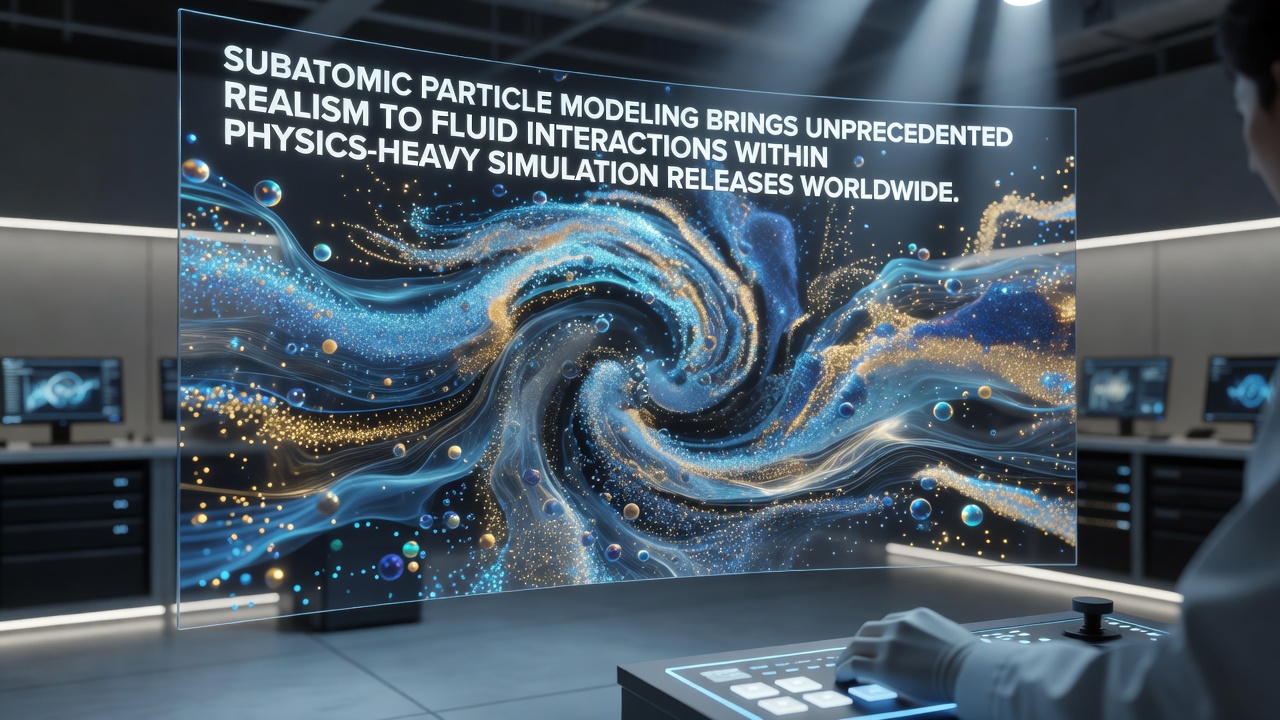
Developers have integrated subatomic particle modeling techniques into simulation software, which allows fluid interactions to achieve new levels of detail across multiple gaming platforms and genres. These methods draw from quantum mechanics principles and particle physics frameworks to calculate molecular behaviors at scales previously reserved for scientific research applications, and the approach has spread through studios in North America, Europe, and Asia since early testing phases began several years ago.
Foundations of the modeling approach
Traditional fluid simulations relied on continuum mechanics equations that treated liquids and gases as uniform volumes, yet subatomic modeling shifts the focus to discrete particle interactions governed by forces at the atomic level. Researchers at institutions such as those affiliated with the European Organization for Nuclear Research have contributed foundational data on particle dynamics that game engines now adapt for real-time computation, while similar work from North American laboratories supplies additional calibration datasets for viscosity and surface tension parameters. The result produces turbulence patterns, droplet formations, and wave propagations that align more closely with observed physical phenomena in controlled experiments.
Engineers implement these models through layered algorithms that track billions of virtual particles simultaneously, and each particle responds to neighboring forces according to probabilistic rules derived from quantum field approximations. Processing occurs on specialized hardware accelerators that handle the increased computational load without interrupting frame rates in current-generation consoles and high-end PCs, whereas earlier attempts at similar granularity required offline rendering that delayed production timelines.
Applications in recent simulation titles
Several major releases scheduled for mid-2026 incorporate these fluid systems in scenarios ranging from maritime navigation challenges to atmospheric effects in open environments. One title set in oceanic exploration uses the particle framework to generate accurate wake formations behind vessels and realistic spray interactions during storms, and another project focused on chemical processing plants demonstrates how modeled fluids mix and react under varying pressure conditions. Observers note that these implementations reduce visual artifacts common in prior generations, such as clipping through surfaces or unnatural settling behaviors.

Independent developers have also adopted scaled versions of the technology for mobile and PC titles that emphasize puzzle mechanics involving liquid manipulation. Data from industry reports compiled by organizations like the Entertainment Software Association indicate that physics-heavy simulations now account for a growing segment of development budgets, with fluid subsystems representing a notable portion of that allocation in titles released after 2024. Integration occurs through middleware libraries that studios license and customize, which accelerates adoption across smaller teams lacking in-house physics specialists.
Performance considerations and hardware evolution
Subatomic particle counts in these simulations often exceed several million per scene during peak activity, yet optimization routines cull unnecessary calculations based on camera distance and interaction relevance. Graphics processing units from multiple manufacturers have added dedicated instruction sets that accelerate the required vector operations, and this hardware support emerged following collaborative standards developed through international working groups in 2025. Memory bandwidth demands remain substantial, which has prompted some studios to implement hybrid approaches combining GPU and CPU workloads for different particle subsets.
Networked multiplayer environments present additional challenges because synchronized fluid states must transmit efficiently between clients, and developers address this through predictive algorithms that extrapolate particle behaviors between update packets. Tests conducted by research teams at universities in Australia and Canada have validated these synchronization methods under high-latency conditions, confirming that visual consistency holds across diverse connection qualities without introducing exploitable discrepancies.
Global adoption patterns
Studios in Japan and South Korea have applied the modeling techniques to simulations involving ink diffusion and atmospheric moisture, while European developers focus on industrial fluid systems in factory management games. North American projects emphasize environmental storytelling through rivers, rainfall, and bodily fluids in narrative contexts. Cross-regional collaborations have produced shared asset libraries that standardize particle behavior profiles, reducing duplication of effort on common scenarios such as splashing and pooling.
Academic partnerships continue to supply updated parameter sets derived from high-precision laboratory measurements, and these contributions appear in patch notes for simulation engines throughout 2026. Conferences organized by groups including ACM SIGGRAPH feature dedicated tracks on real-time physics adaptations, where presenters share benchmarks comparing subatomic approaches against legacy methods across standardized test scenes.
Conclusion
Subatomic particle modeling has expanded the capabilities of fluid simulation in physics-intensive releases by translating research-derived particle interactions into playable environments. The technique continues to evolve through ongoing hardware improvements and data exchanges between scientific and entertainment sectors, supporting more accurate representations in titles distributed worldwide.